Engine Valve Aftermarket Trends: What Distributors Should Watch in the EV Era
Market-driven engine valve aftermarket trends: aging vehicle fleets, rising hybrid adoption, growing demand for component rebuilds in emerging markets and increasing component specifications — plus stocking guidance for wholesale distributors.
2026/11/20
Reading volume: 0
News Details
The engine valve aftermarket keeps growing — even as EVs grab headlines
Electric vehicles dominate automotive headlines, but the parts that keep combustion engines running are quietly entering their strongest decade in years. Market research firm Mordor Intelligence estimates that the independent engine valve aftermarket is advancing at roughly 4.11% a year, driven less by new car production than by the simple fact that the world's combustion fleet is getting older. For auto parts distributors, the engine valve aftermarket is becoming a steadier, better-margin business than many assume — but only for those who understand which demand signals actually matter.
This article reviews the trends behind engine valve market growth, where demand is rising fastest, and what those shifts mean for your assortment and pricing in 2027 and beyond.
Why aging vehicle fleets drive engine valve market trends
The single most important force behind engine valve market trends is vehicle age. Mordor Intelligence notes that the average age of cars in the United States reached 13.6 years in 2024 — a record. IndexBox analysis reaches a similar conclusion from a different angle: with the global internal-combustion vehicle parc still numbering well over one billion units, the aftermarket is entering what it describes as a prolonged growth phase sustained by servicing and repairing existing engines rather than building new ones.
Valves sit squarely in this trend. They are wear components: exhaust valves in particular cycle through extreme temperatures every second the engine runs. As engines accumulate mileage, overhaul demand rises, and a valve that was replaced once at 150,000 km may be replaced again at 300,000 km. An aging vehicle fleet parts demand pattern like this is predictable — it follows the calendar, not the sales cycle — which is exactly why distributors value it.
ICE parts demand: the base is still widening
The second trend is that ICE parts demand is not simply shrinking as electrification advances. Several market studies converge on the same picture. Mordor Intelligence reports that OEM build cycles still accounted for over 76% of engine valve demand in 2025, and that while battery-electric penetration reduces some passenger-car ICE volume, commercial vehicle production continues to expand. Market Intelo projects that conventional ICE and hybrid powertrains will remain dominant in volume terms through 2034, keeping traditional valve demand on a growth path. IndexBox adds a structural point: new ICE platform launches will peak and then decline, but the surviving engine families will carry higher valve content per engine — and winning those "last generation" programs will concentrate volume among suppliers who can hold cost and specification simultaneously.
Hybrid vehicles are an underrated contributor here. A hybrid still needs a full set of combustion valves, and because the engine switches on and off frequently, thermal cycling is arguably harsher than in a conventional car. Demand for durable hybrid engine valves therefore grows with every hybrid sold — one reason aftermarket watchers treat hybrids as a demand floor rather than a transitional niche.
Alternative fuels add a further layer of demand. Mordor Intelligence points to Nigeria's policy focus on compressed natural gas (CNG) and Egypt's incentives for gas conversion as drivers of aftermarket valve demand in Africa, while market analysts expect hydrogen and CNG engines for trucks and buses to require valves and seat pairs that resist dry running and higher temperatures. Each new fuel or duty cycle raises the specification on the valve — and with it, the value of suppliers who can document material and heat-treatment compliance.
Engine rebuild parts in emerging markets: the volume engine
Emerging markets are where aging-fleet economics play out most visibly. Radial Insights observes that most African demand comes from overhauls of older imported vehicles, while South America and the Middle East — smaller markets by value today — are growing faster than developed regions. Three regional specifics stand out:
- Brazil: flex-fuel engines running high ethanol blends need corrosion-resistant valves, pushing demand toward upgraded materials.
- The Gulf: hot climates and dusty roads accelerate valve and seat wear, raising replacement frequency for both intake and exhaust positions.
- Africa: with much of the parc built from used imports, engine rebuild parts in emerging markets are overwhelmingly a coverage game — distributors who stock complete valve sets for popular older engines win the ticket.
For a supplier base like ours in Ruian, Zhejiang — exporting engine valves for Geely, Weichai and Great Wall applications alongside Toyota exterior parts — these are precisely the markets our wholesale partners serve.
Emission rules are raising the technical bar — and the ticket size
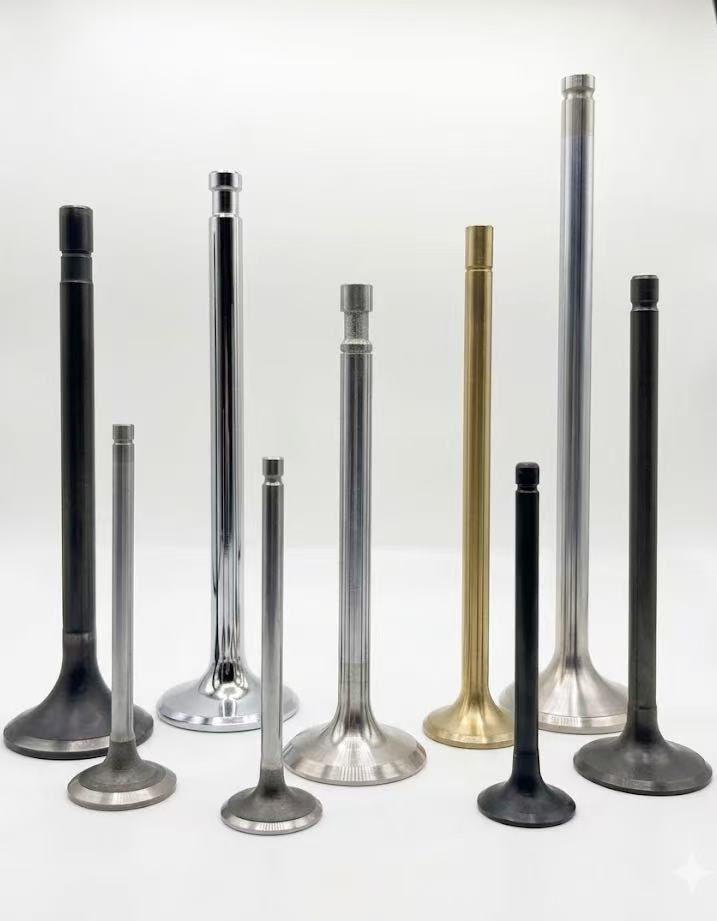
The third trend is regulatory. Stricter emission standards such as Euro 7 and China 6b push automakers toward higher-precision valvetrain components, and market researchers expect the same specification logic to flow into the replacement market. Radial Insights notes that Euro 7 rules favour premium exhaust valves; Market Intelo points to sodium-filled exhaust valves and coated stems lifting average selling prices. In plain terms: the replacement valves your customers will ask for over the next five years are more technical, not less — and technical parts are harder to substitute with low-quality copies.
This matters for sourcing. A valve specified for a turbocharged, emission-controlled engine must hold tolerances on stem diameter, head concentricity and heat treatment that a generic part may not. Distributors who qualify suppliers on measurable specifications — rather than catalogue photos alone — are better positioned as the bar rises.
What the trends mean for your valve assortment
Reading the signals together suggests a practical stocking logic:
| Market signal | Distributor action |
| Fleet age keeps rising (13.6 years in the US per Mordor Intelligence) | Extend part-number coverage to older engines, not just current models |
| Emerging-market overhaul demand growing fastest | Prioritise complete intake/exhaust pairs for high-volume older engines |
| Hot climates accelerate valve and seat wear | Spec heat-resistant exhaust valves for Gulf and African programs |
| Emission rules favour premium components | Qualify suppliers on dimensional and hardness evidence per batch |
None of these actions requires predicting the future. Each follows from a trend already visible in fleet data and market research.
A note on reading market numbers
Different research houses size the valve market differently — estimates of the aftermarket's share of total valve revenue range from about 28% (Market Intelo) to roughly a third of total demand in other studies — and growth rates cluster around 3.8–4.1% a year. The precise figures matter less than the direction: every credible source agrees the replacement market is growing while new-vehicle ICE content concentrates into fewer engine families. Treat vendor numbers as directional evidence, and validate demand for your own territory against registration or workshop data where you can access it.
How to validate the trends in your own territory
Global numbers set the direction, but ordering decisions happen at the territory level. Three practical checks bring the trends home. First, look at your market's registration or insurance data for the average age of the vehicles your customers service — if it trends above ten years, overhaul-driven valve demand is already a majority of your opportunity. Second, track which engine families appear most often in workshop intake records; those part numbers belong at the top of your stocking list ahead of anything the sales charts suggest. Third, ask suppliers for batch-level inspection evidence on the specific applications you plan to carry, and compare it against the failure patterns your workshop customers report. Where global research and local records agree, order with confidence; where they disagree, trust the local data.
How Gold Auto Part fits into this picture
We manufacture and export engine valves for Geely, Weichai and Great Wall engine applications, together with Toyota exterior parts and oil and air filters, serving wholesale buyers across the Middle East, South America, Southeast Asia and Africa. Production runs under ISO 9001 and IATF 16949 quality systems, with batch-level inspection covering dimensions, hardness and surface finish before shipment. For distributors building programs around the trends above, we support part-number selection against your market's engine parc, sample batches for fitment verification, and packing designed for mixed-container consolidation.
The combustion fleet is not disappearing — it is aging, spreading to new markets, and demanding better parts each year. The engine valve aftermarket is where that reality shows up first. Contact Gold Auto Partto discuss a valve program matched to your market.
Share to:


