Engine Valve Price: Exploring the Variables Behind Wholesale Quotation Disparities
Why engine valve prices differ between suppliers: the cost stack behind a quotation — material and heat treatment, machining precision, MOQ and tiered pricing, Incoterms, packing and inspection scope — and how to compare quotations on total landed cost.
2026/11/16
Reading volume: 2
News Details
Ask three suppliers for the same engine valve and you will often receive three engine valve price figures that differ by a factor of two or more — sometimes far more, since publicly listed market prices for this category span from cents to hundreds of dollars per piece depending on application and specification. That spread is not simply margin gamesmanship. A valve quotation is the compressed output of material choices, machining depth, order volume, packing scope and the trade term the price is based on. This guide breaks down what actually drives an engine valve price apart between suppliers, so you can compare quotations on substance instead of reacting to the lowest number.
The Cost Stack Behind an Engine Valve Price
Every valve quotation is built from the same stack of engine valve cost factors, and suppliers weight them differently:
- Raw material — the alloy the valve body and seat face are made from.
- Forging and machining — head forming, stem grinding, seat face cutting and finish.
- Heat treatment and surface engineering — tip hardening, stem chrome plating, seat hardfacing where specified.
- Inspection and batch control — dimensional sampling, material verification, performance testing before shipment.
- Packaging — stem protection, carton specification, private-label work.
- Margin and volume — the supplier's pricing structure and how your quantity amortizes fixed costs.
When one quotation undercuts another by a wide margin, one or more of these items has been reduced, removed or redefined. The buyer's job is to find out which one — before the container ships, not after the first warranty claim.
Material and Heat Treatment: The Largest Cost Split
Industry market research on valve manufacturing consistently identifies raw material as the dominant cost item — commonly estimated at roughly 40 to 55 percent of manufacturing cost for standard valves, and higher still for premium exhaust valves with hardfaced seats. Alloys for hot-duty exhaust applications carry nickel, chromium and cobalt content whose prices have been volatile in recent years, which is why some supply contracts include material-index adjustment clauses rather than fixed prices.
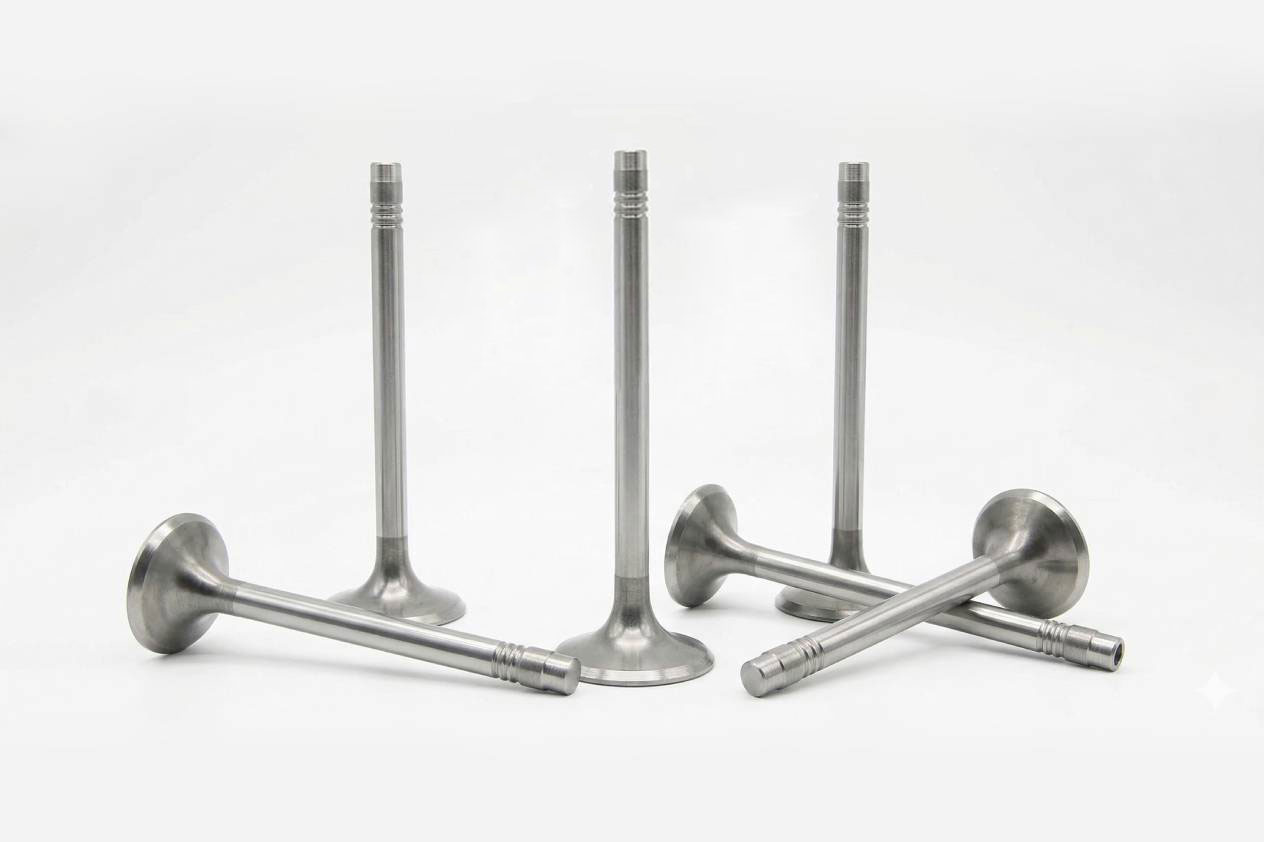
Because material drives both cost and performance, this is the first item to pin down in writing. Reputable suppliers state the material specification each part number is made to, the heat-treatment process applied to the tip and seat areas, and the records kept per batch. Our supply chain operates under ISO 9001 and IATF 16949 quality management standards, and material verification is part of the standard batch process before shipment. A quotation that cannot be backed by a stated material standard is not cheaper — it is unspecified.
The Machining Precision You Are Actually Paying For
Two valves can look identical in a photograph and sit at opposite ends of the price range because of what machining tolerance their specification demands. Seat face finish and runout determine how well the valve seals; stem diameter tolerance determines guide fit; lock groove and tip geometry determine valvetrain durability. Tighter tolerances mean more grinding passes, more measurement and more rejects scrapped at inspection — all real cost that shows up in the quotation.
This is also why dimension matters commercially, not just technically. Across engine platforms, stem diameters range from 5 mm on small passenger-car engines to 10.5 mm on heavy-duty diesel engines, and every dimension must match the engine specification rather than a "similar-looking" part. A supplier who quotes without asking for the engine series, position and three dimensions is pricing a guess.
Order Volume, MOQ and Tiered Pricing
Wholesale MOQ pricing exists because fixed costs — setup, tooling changeover, first-article inspection — do not shrink when the order does. Spreading those costs over 1,000 pieces costs far less per piece than over 50. This is why publicly listed offers in this category show MOQs anywhere from a single piece for stock clearance to thousands for production runs, with unit prices falling at each tier.
For made-to-order valves, realistic commercial parameters are MOQs of 50 to 100 units per part family and production lead times of 30 to 60 days. Two practical rules follow. First, do not compare a price quoted at MOQ against one quoted at container volume — normalize the quantity first. Second, on unproven SKUs, buy at or near MOQ: the higher unit price is the premium for information, and the second, larger order is where volume pricing belongs.
EXW vs FOB vs CIF: Normalize the Basis Before You Compare
A frequent source of fake price gaps is comparing quotations built on different trade terms. Under EXW, the buyer collects at the factory and bears everything beyond the gate. Under FOB, the price includes delivery onto the vessel at the named Chinese port, including export clearance. Under CIF, it also covers main freight and minimum insurance to the destination port — but not import clearance, duties or inland delivery.
A CIF quote that looks 12 percent "more expensive" than an EXW quote may be the better total price once freight is added to the EXW figure. Before you compare supplier quotations at all, put every supplier on the same Incoterm, the same named port and the same currency — otherwise you are comparing products of different scope, not prices.
What a Comparable Quotation Should Itemize
Two quotations at the same unit price can still differ materially in what they include. A comparable engine valve quotation states, in writing:
- Specification — engine series, intake or exhaust position, and the three controlling dimensions, per part number.
- Material and process standard — the specification the valve is made to, and the treatments applied.
- Packing scope — stem protection, pieces per carton and carton dimensions; packaging arranged to customer requirements, whether neutral export cartons or private-label boxes, is quoted explicitly rather than assumed.
- Inspection scope — what is checked per batch (dimensional sampling, material verification, performance testing) and what records are issued.
- Lead time and quantity basis — production time after order confirmation, quoted at the same quantity for every supplier.
Items that are missing from a quotation are not free. They are either excluded or being absorbed invisibly — and both cases surface later as claims. Packing differences in particular are genuine auto parts packaging cost: reinforced cartons, individual stem protection and label work are quoted items, not courtesies.
Compare on Total Landed Cost, Not Unit Price
The unit price is one line in the landed-cost calculation. Freight, insurance, import duties, port and clearance charges, and inland transport all sit between the quoted price and the cost of a valve on your shelf. Beyond the visible items sit the probabilistic ones: the cost of a fitment dispute, a rejected batch, or a warranty claim traced to an unspecified material. Distributors who buy solely on unit price pay for those risks later, at retail, where they are far more expensive to resolve.
A practical comparison therefore scores each quotation on total landed cost per sellable part — including the expected return rate implied by the supplier's inspection scope and documentation — rather than on the number at the bottom of the quote.
A Checklist for Requesting an Engine Valve Price
To receive quotations you can actually compare, send every supplier the same inquiry built from these items:
- Engine series and model (not the vehicle nickname), intake or exhaust position
- The three controlling dimensions per part number — head diameter, stem diameter, overall length — or a sample
- Quantity per part number and per order, stated at the tier you intend to buy
- Material standard and required treatments, or a request for the supplier's written specification
- Packing requirement: carton specification, private label or neutral, pieces per carton
- Incoterm and named port; currency
- Inspection scope and the batch records you expect to receive
Suppliers who answer all seven items precisely are pricing a real product. Suppliers who return a bare number are pricing an assumption — and the difference between the two is exactly what an engine valve price is supposed to reflect.
Request a Comparable Engine Valve Quotation from Gold Auto Part
Gold Auto Part (Ruian Golden Import and Export Co., Ltd.) is an automotive parts exporter based in Ruian, Wenzhou, supplying OEM-specification engine valves for Geely, Weichai and Great Wall engine platforms alongside Toyota exterior parts and oil and air filters, serving importers and distributors across the Middle East, Saudi Arabia, UAE, South America, Southeast Asia, Africa and Europe.
Send your engine list and the seven inquiry items above, and we will return a quotation itemized to the same standard — specification, packing, inspection and lead time included. Visit www.goldautopart.com to request a quotation.
Share to:


