How to Choose a Wholesale Engine Valve Manufacturer for Automotive Parts
Practical Sourcing Guide for Importers and Distributors: Evaluation of Engine Valve Manufacturers, Including Materials, OEM Specification Control, Dimensional Accuracy, IATF 16949 Quality System and Pre-shipment Inspection, Before Committing to Wholesale Programs
2026/11/13
Reading volume: 2
News Details
Engine valves are small components that play a decisive role in the reliability of an engine. For importers, wholesalers, and engine rebuilders, the difference between a dependable valve program and a stream of warranty claims usually comes down to how the manufacturer controls materials, machining, and inspection. This guide walks through the key criteria to evaluate when choosing an engine valve manufacturer, from intake and exhaust valve materials to quality-system documentation and pre-shipment checks.
Why Your Choice of Engine Valve Manufacturer Matters
A valve operates in one of the harshest environments inside an engine. Intake and exhaust valves open and close thousands of times per minute, seal against high cylinder pressure, and on the exhaust side, withstand gas temperatures that can exceed 600°C. A valve with inconsistent hardness, an out-of-tolerance stem, or a poorly machined seat face will wear guides, lose compression, and eventually burn — and the failure will show up in your customers' engines, not yours.
That is why experienced buyers treat supplier selection as an engineering decision, not a price comparison. The questions below are the ones that separate a reliable valve source from a risky one.
Intake Valve Supplier Criteria: Materials, Machining, and Fitment
When you evaluate an intake valve supplier, start with the material specification. Intake valves run cooler than exhaust valves because incoming air and fuel cool the head, so most are made from alloy steels or chromium-silicon steel, with stainless steel used in many passenger-car applications. What matters for a wholesale buyer is consistency: the alloy certificate behind each batch, the hardening process at the stem tip, and the seat face finish that determines how well the valve seals after lapping.
Fitment data is the second pillar. A supplier should be able to state, for every part number, the head diameter, stem diameter, and overall length against an OEM specification — not approximate values. Ask how the supplier verifies each dimension and how deviations are documented.
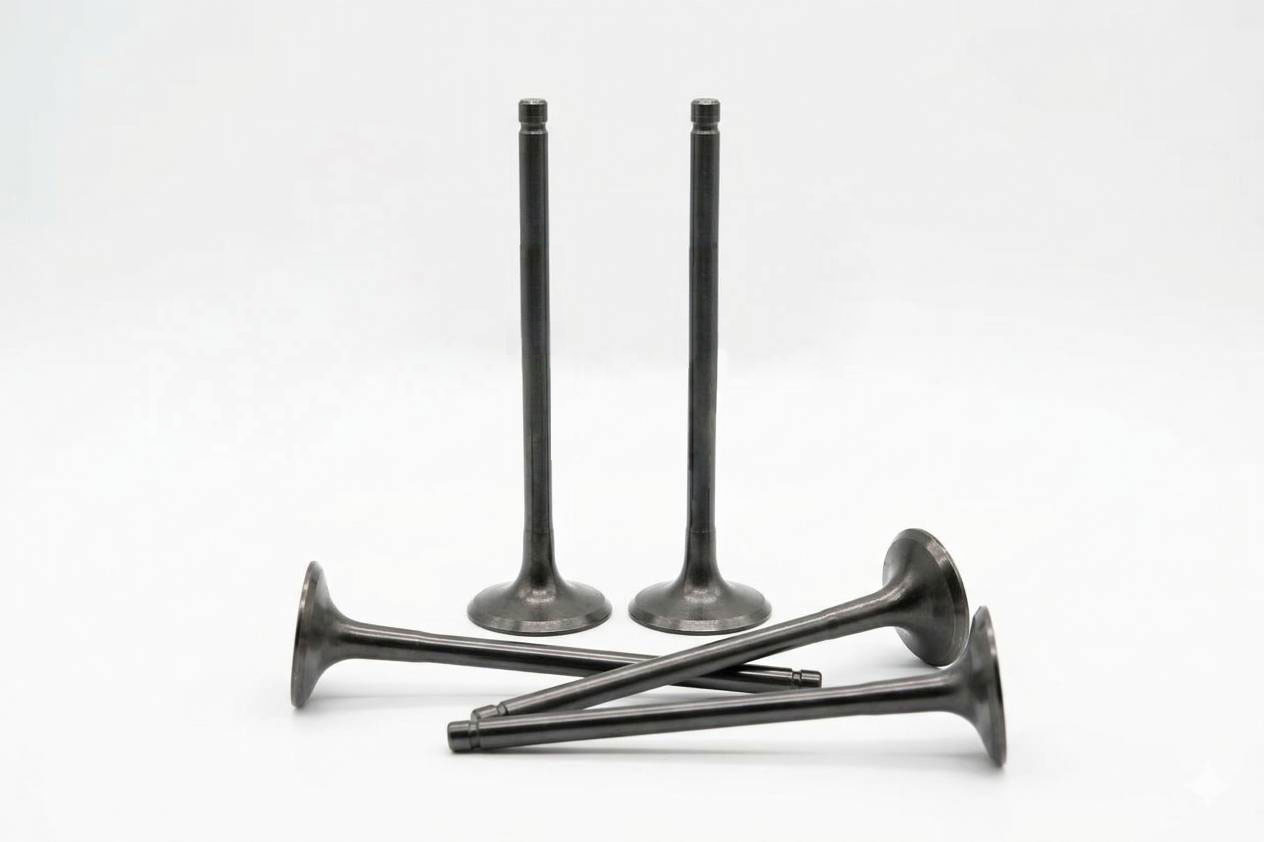
Exhaust Valve Factory Capabilities: Heat Resistance First
Exhaust valves face far harsher conditions, so an exhaust valve factory should be able to explain its heat-management choices in detail: austenitic stainless steels such as 21-4N, sodium-cooled hollow stems for high-duty applications, Stellite hardfacing on seat faces, and chrome-plated stems for high-temperature wear resistance. For buyers serving Gulf, Middle East, and tropical markets, heat resistance is not optional — sustained high ambient temperatures and heavy loads push exhaust valve temperatures close to their material limits.
Ask the factory which of these features are standard and which are optional, and request the material certificates that back each claim. A capable supplier answers with specifications and process documents, not marketing language.
Sourcing Engine Valves Wholesale: MOQ, Packaging, and Lead Times
Wholesale valve programs are won and lost on logistics. Before committing to a volume, confirm three things with your engine valve wholesale partner:
- MOQ by part number, not just by order. Fast-moving passenger-car valves and slow-moving diesel valves rarely share the same minimums.
- Packaging flexibility. Valves must arrive protected against stem damage and seat-face scoring. Our catalog ships with packaging arranged to customer requirements — retail-ready boxes, bulk export cartons, or private-label packaging.
- Realistic lead times, including production scheduling for made-to-order OEM-spec parts and consolidation for mixed containers.
Gold Auto Part supplies full-container valve programs alongside Toyota exterior parts and oil and air filters, which allows distributors to consolidate a wider parts program into one shipment.
OEM Engine Valves vs. Aftermarket Replacements
Terminology matters commercially. An OEM engine valve is produced to the original equipment specification — the same dimensions, materials, and tolerances the engine maker defined. An aftermarket engine valve is a replacement part built to serve the same function, and its quality depends entirely on the discipline of the producer.
Reputable suppliers use "OEM specification" to describe parts manufactured to OE dimensions and materials — never to imply the part came from the vehicle maker. When you compare quotes, ask each supplier exactly which of the following they provide:
- Valves produced to published OEM specification dimensions and materials
- OE reference numbers or engine-model cross-references for each part number
- Documented tolerances, so "same size" is verifiable rather than asserted
Suppliers who cannot answer these questions precisely are the most common source of fitment disputes and returns.
Verifying Valve Stem Size and Overall Length
Valve stem size is the dimension buyers most often get wrong, because catalogs sometimes list only head diameter. The stem diameter must match the valve guide bore, and overall length must match the valvetrain geometry — a valve a few millimeters too long or too short changes spring preload and valve lift.
Always verify three measurements against the engine specification before fitting or before accepting a batch:
| Valve Model | Intake Valve (Head Ø × Stem Ø × Length, mm) | Exhaust Valve (Head Ø × Stem Ø × Length, mm) |
| Geely 2.0T | 31 × 6 × 109.2 | 26.9 × 6 × 110.6 |
| Geely 1.5T | 30.5 × 6 × 113 | 26.5 × 6 × 107 |
| Weichai P7 | 38 × 8 × 141.4 | 35.8 × 8 × 141.4 |
| Weichai P12 | 43.5 × 9 × 173.5 | 41 × 9 × 173 |
| Weichai P15 (Diesel) | 48 × 10.5 × 207.2 | 44 × 10.5 × 214.7 |
| Great Wall 4D20 | 28.8 × 6 × 99 | 24.8 × 6 × 98 |
| Great Wall 4N20 | 33 × 6 × 99.4 | 28 × 6 × 115 |
Note how stem diameters range from 6 mm on modern passenger-car engines to 10.5 mm on heavy-duty diesel platforms. Measuring with a micrometer at goods-in — stem diameter, overall length, and head diameter — takes minutes per batch and catches most mix-ups before they reach your customers.
IATF 16949 and ISO 9001: Documents to Request from an Auto Parts Supplier
Quality certificates are only useful when you can verify their scope. When you assess an IATF 16949 auto parts supplier, request:
- The certificate itself, including scope, registration body, and validity dates
- Evidence of batch traceability from raw material to finished valves
- Process control documents for heat treatment and hardfacing
Our supply chain partners operate under ISO 9001 and IATF 16949 quality management standards, and every product batch undergoes dimensional inspection, material verification, and performance testing before shipment. Asking for the same documentation from any supplier you evaluate is a reasonable, standard request — serious manufacturers expect it.

A Practical Engine Valve Quality Check Before Shipment
Even with certificates in hand, a pre-shipment engine valve quality check protects both sides. A workable minimum checklist:
- Dimensional sampling — head diameter, stem diameter, and overall length measured against the agreed specification, with the sampling plan agreed in advance.
- Material verification — alloy certificates matched to the purchase order; hardness spot checks on stem tips where specified.
- Surface and seat-face inspection — seat face finish, stem surface condition, and lock-groove condition checked on sampled valves.
- Packaging check — stems protected, valves separated by part number, carton quantities matching the packing list.
Document results per batch. If a supplier resists batch-level records, treat that as a warning sign before the first container, not after.
Sourcing Engine Valves with Gold Auto Part
Gold Auto Part (Ruian Golden Import and Export Co., Ltd.) is an automotive parts exporter based in Ruian, Wenzhou — one of China's most established auto parts manufacturing hubs. We supply engine valves to OEM specification for Geely, Weichai, and Great Wall engine platforms, together with Toyota exterior parts and oil and air filter programs, serving importers and distributors across the Middle East, Saudi Arabia, UAE, South America, Southeast Asia, Africa, and Europe.
Whether you are sourcing a full container of engine valves or building a mixed parts program, visit www.goldautopart.com to request a catalog or get a quotation.
Share to:


